Albert Einstein & William Shakespeare
A physicist and a playwright explore the nature of creativity and human understanding
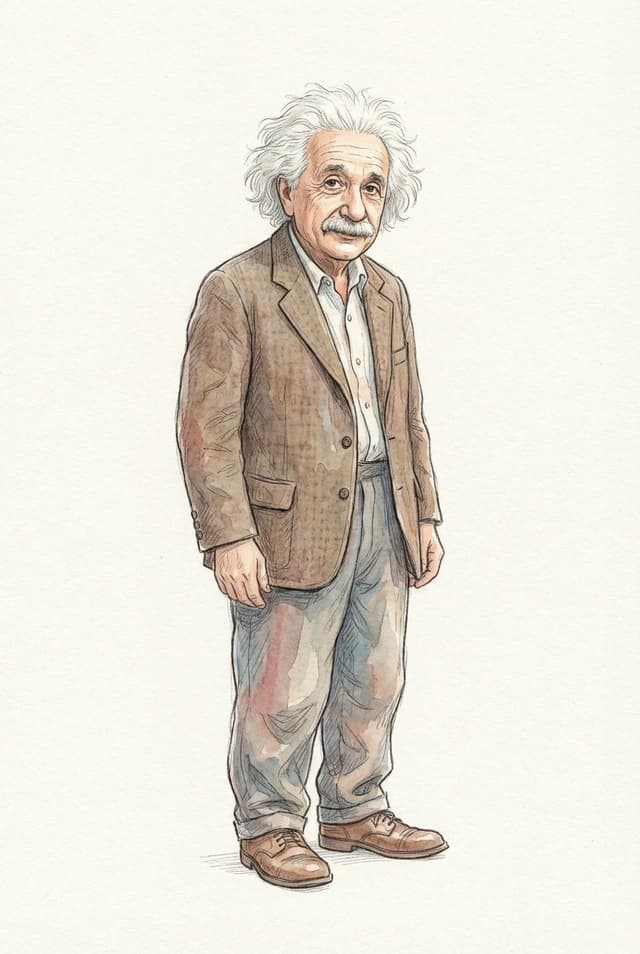
Albert Einstein
1879–1955 · German-American
Theoretical physicist whose theories of relativity revolutionized our understanding of space, time, and the universe. His equation E=mc² became the most famous in science.
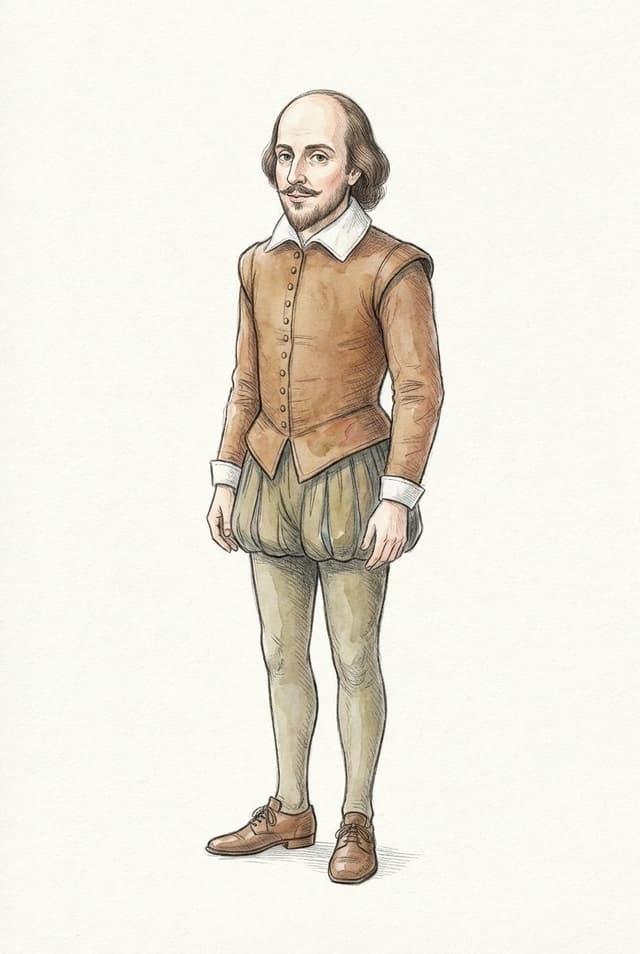
William Shakespeare
1564–1616 · English
The Bard of Avon, whose plays and sonnets explored the full range of human experience. His influence on the English language and literature remains unmatched.
Their Lifetimes
263 years apart William Shakespeare
 Albert Einstein
Unexpected Parallels
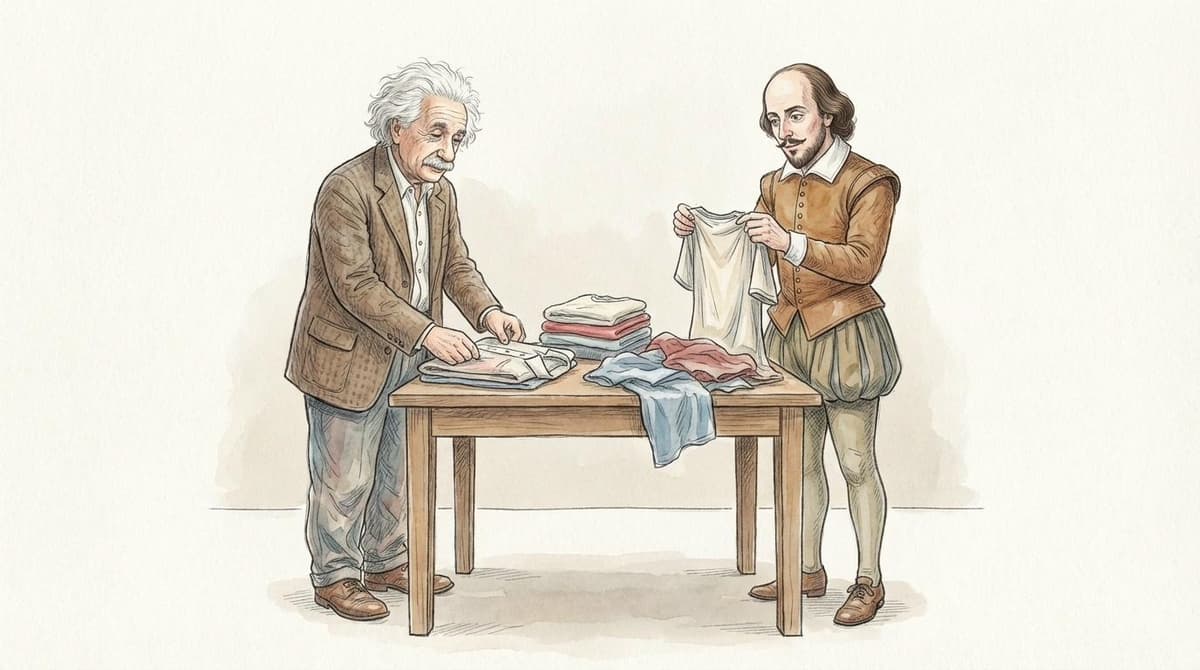
A physicist who bent space and time, a playwright who bent language and emotion—two minds that each transformed how humanity understands itself. Einstein revealed that the universe is stranger than common sense suggests: time slows, space curves, matter and energy interconvert. Shakespeare revealed that the human heart is equally strange: we are noble and base, loving and murderous, rational and mad. Both worked through thought experiments—Einstein imagining riding a beam of light, Shakespeare imagining a Danish prince paralyzed by indecision. Both created new vocabularies: Einstein gave us "relativity" and "spacetime," Shakespeare invented "assassination" and "lonely." Both achieved a kind of immortality, their ideas so fundamental that we can barely imagine thinking without them.
About Albert Einstein
Albert Einstein showed little early promise—he was slow to speak and chafed against the rigid discipline of German schools. Working as a patent clerk in Bern, he spent his spare hours contemplating the nature of light and motion. In 1905, his "miracle year," he published four papers that would transform physics, including special relativity and his explanation of the photoelectric effect.
His general theory of relativity, completed in 1915, reimagined gravity not as a force but as the curvature of spacetime itself. The confirmation of his predictions during a 1919 solar eclipse made him an international celebrity. Einstein spent his later years at Princeton, searching unsuccessfully for a unified field theory while becoming an outspoken advocate for pacifism and civil rights. He rejected quantum mechanics' randomness with his famous objection that God does not play dice. His wild hair and absent-minded manner made him an icon of genius itself.
About William Shakespeare
William Shakespeare was born in Stratford-upon-Avon to a successful glove-maker. He married Anne Hathaway at eighteen, had three children, then largely disappeared from historical record until appearing in London's theatre world in his late twenties. What happened during these "lost years" remains one of literary history's great mysteries.
In London, Shakespeare became an actor, playwright, and part-owner of the Globe Theatre. Over two decades, he wrote approximately 37 plays and 154 sonnets, inventing words, perfecting the sonnet form, and creating characters of unprecedented psychological depth. His plays move effortlessly from bawdy comedy to profound tragedy, from history to fantasy. He retired to Stratford a wealthy man, dying at 52. Yet for all his fame, we know remarkably little about him personally—a mystery that only deepens the fascination with the man who understood human nature better than anyone before or since.
Shared Experiences
🤝- ✦ Transformed human understanding so fundamentally that we can barely imagine thinking without their contributions
- ✦ Created new vocabularies and concepts that became permanent fixtures of their fields
- ✦ Worked primarily through imagination and thought experiments rather than pure observation
- ✦ Achieved fame that transcended their specific disciplines to become cultural icons
- ✦ Left behind mysteries about their personal lives and creative processes that continue to fascinate scholars
Worlds Apart
Albert's WorldWilliam's World- ✦ Mathematical equations as primary tools
- ✦ Revealed the structure of the cosmos
- ✦ Work requires years of specialized training to understand
- ✦ Published in academic journals
- ✦ Fame came from scientific confirmation
- ✦ Words and human emotion as primary tools
- ✦ Revealed the structure of the heart
- ✦ Work accessible to anyone who can read
- ✦ Performed for groundlings and queens alike
- ✦ Fame came from popular entertainment
The Conversation