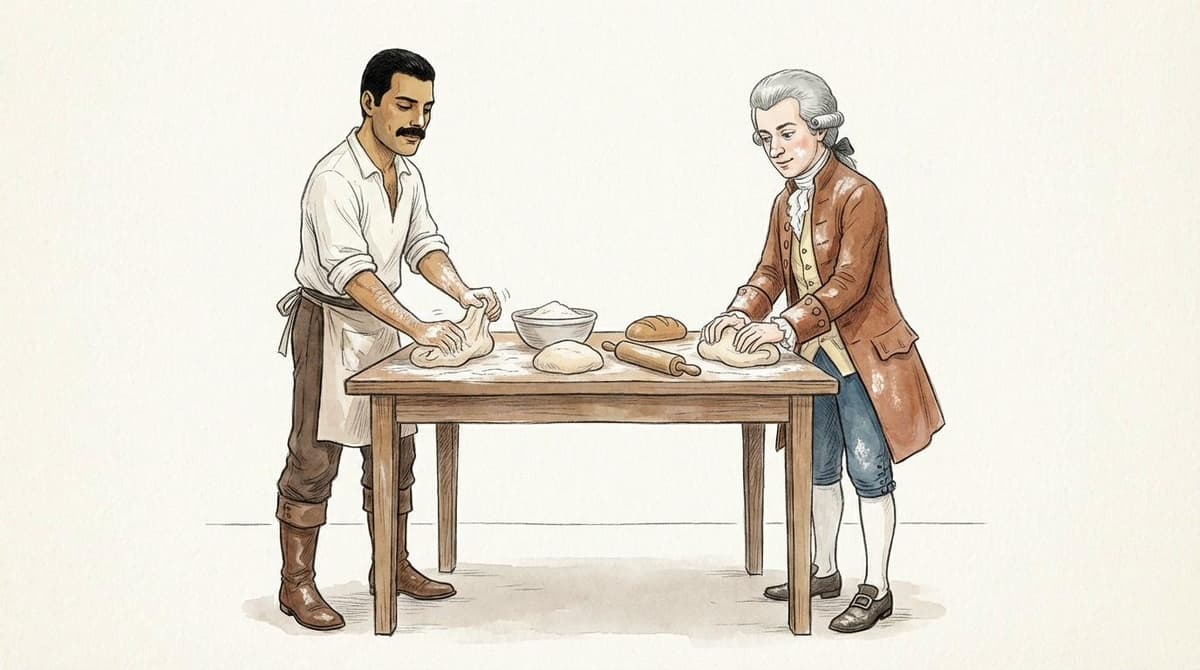
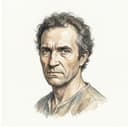
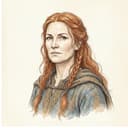
Freddie Mercury & Wolfgang Amadeus Mozart
Two legendary performers discuss the art of captivating an audience
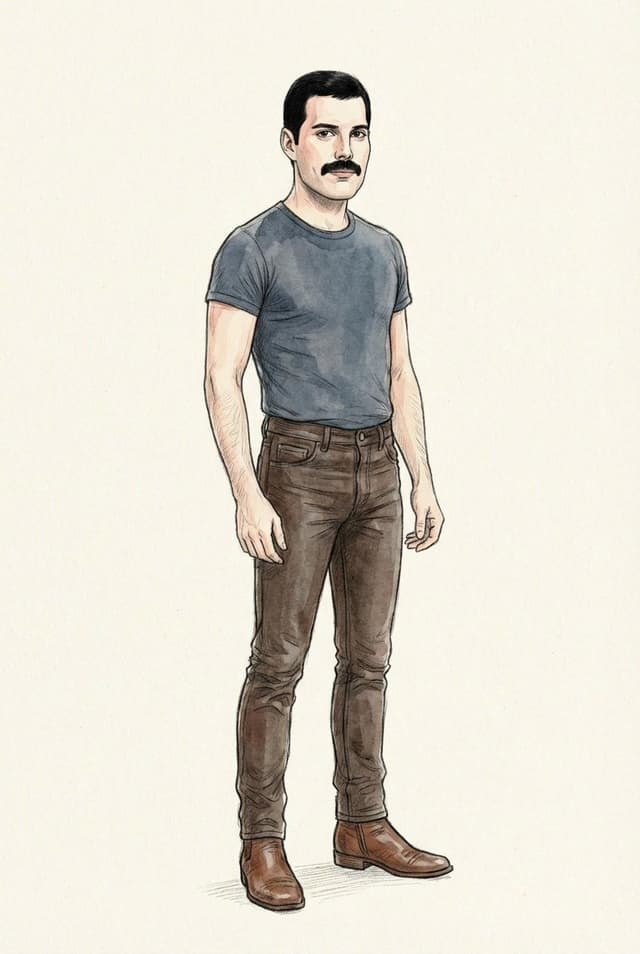

Freddie Mercury
1946–1991 · British
Lead vocalist of Queen whose four-octave range and theatrical performances made him one of rock's greatest frontmen. Born Farrokh Bulsara in Zanzibar.
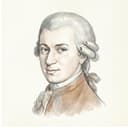
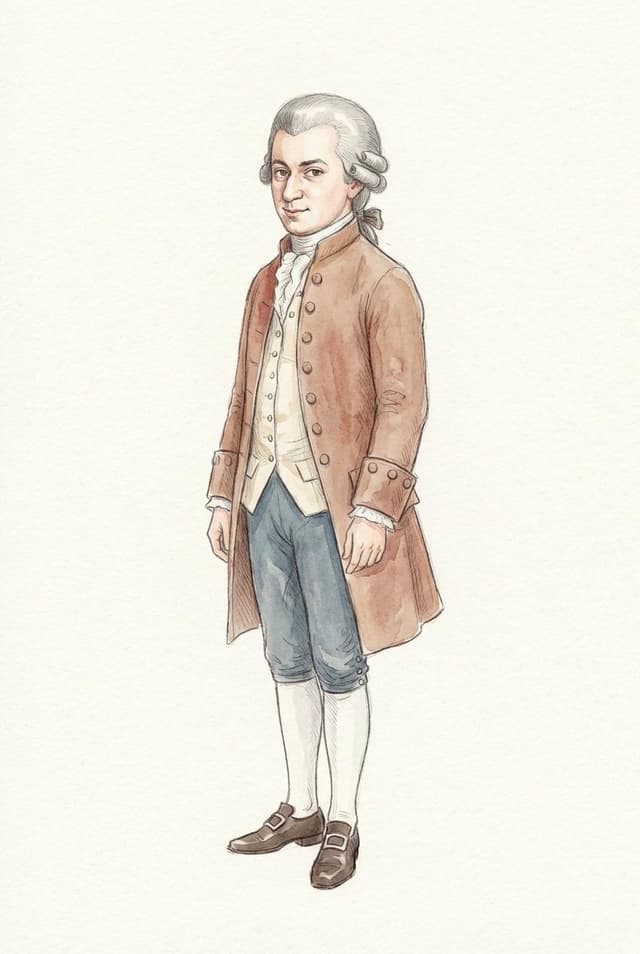
Wolfgang Amadeus Mozart
1756–1791 · Austrian
Child prodigy who became one of history's most influential composers. His works span symphonies, operas, and concertos that still define classical music.
Their Lifetimes
155 years apart Wolfgang Amadeus Mozart
 Freddie Mercury
Unexpected Parallels
Two centuries separate these musical revolutionaries, yet their stories rhyme in remarkable ways. Both were child prodigies whose early fame shaped their adult struggles. Both pushed against the conventions of their eras—Mozart fighting aristocratic patronage, Freddie defying rock's narrow definitions. Each possessed an extraordinary range: Mozart's compositions spanning from playful divertimenti to profound requiems, Freddie's voice soaring from tender ballads to operatic crescendos. Both died young, leaving their art to speak eternally. Most striking is their shared understanding that great performance requires more than technical skill—it demands the courage to be completely, vulnerably oneself before an audience.
About Freddie Mercury
Freddie Mercury was born Farrokh Bulsara in Stone Town, Zanzibar, to Parsi-Indian parents. He spent much of his childhood in India, where he began taking piano lessons at age seven and formed his first band at school. His family fled to England during the Zanzibar Revolution in 1964, where he would eventually reinvent himself.
As the frontman of Queen, Freddie pushed the boundaries of rock music with operatic vocals, theatrical performances, and genre-defying compositions. "Bohemian Rhapsody" exemplified his vision—a six-minute epic that defied radio conventions yet became a global phenomenon. On stage, he commanded audiences of hundreds of thousands with seemingly effortless charisma. In private, he was shy and introspective. He lived openly as a gay man when doing so required courage. His death from AIDS in 1991 robbed music of one of its most innovative and electrifying performers.
About Wolfgang Amadeus Mozart
Wolfgang Amadeus Mozart was composing by age five and performing before European royalty by six. Born in Salzburg to Leopold Mozart, a successful composer and teacher, Wolfgang spent his childhood touring Europe's courts, dazzling audiences with his precocious talent. By his teens, he had already written several symphonies and operas.
As an adult, Mozart struggled against the patronage system that constrained composers to serving nobility. He moved to Vienna, married against his father's wishes, and attempted to forge an independent career—a revolutionary concept for musicians of his era. His output was staggering: over 600 works including "The Magic Flute," "Don Giovanni," and his Requiem. His music balanced technical brilliance with emotional depth, combining playfulness with profound beauty. He died at 35, likely from rheumatic fever, leaving his Requiem unfinished and the world forever wondering what masterpieces remained unwritten.
Shared Experiences
🤝- ✦ Musical prodigies whose extraordinary talents emerged in childhood and defined their lives
- ✦ Revolutionized their genres by refusing to accept conventional limitations on their art
- ✦ Struggled with the gap between public persona and private self throughout their careers
- ✦ Created works that blended technical virtuosity with deep emotional authenticity
- ✦ Died tragically young, leaving behind legacies that continue to influence musicians worldwide
Worlds Apart
Freddie's WorldWolfgang's World- ✦ Performed before stadium crowds of 100,000+
- ✦ Multi-track recording and studio technology
- ✦ Global fame through mass media
- ✦ Electric guitars and synthesizers
- ✦ Died from a modern epidemic (AIDS)
- ✦ Court performances for dozens of nobles
- ✦ Live performance was the only option
- ✦ Fame limited to European aristocracy
- ✦ Harpsichords and orchestras
- ✦ Died from infectious disease
The Conversation